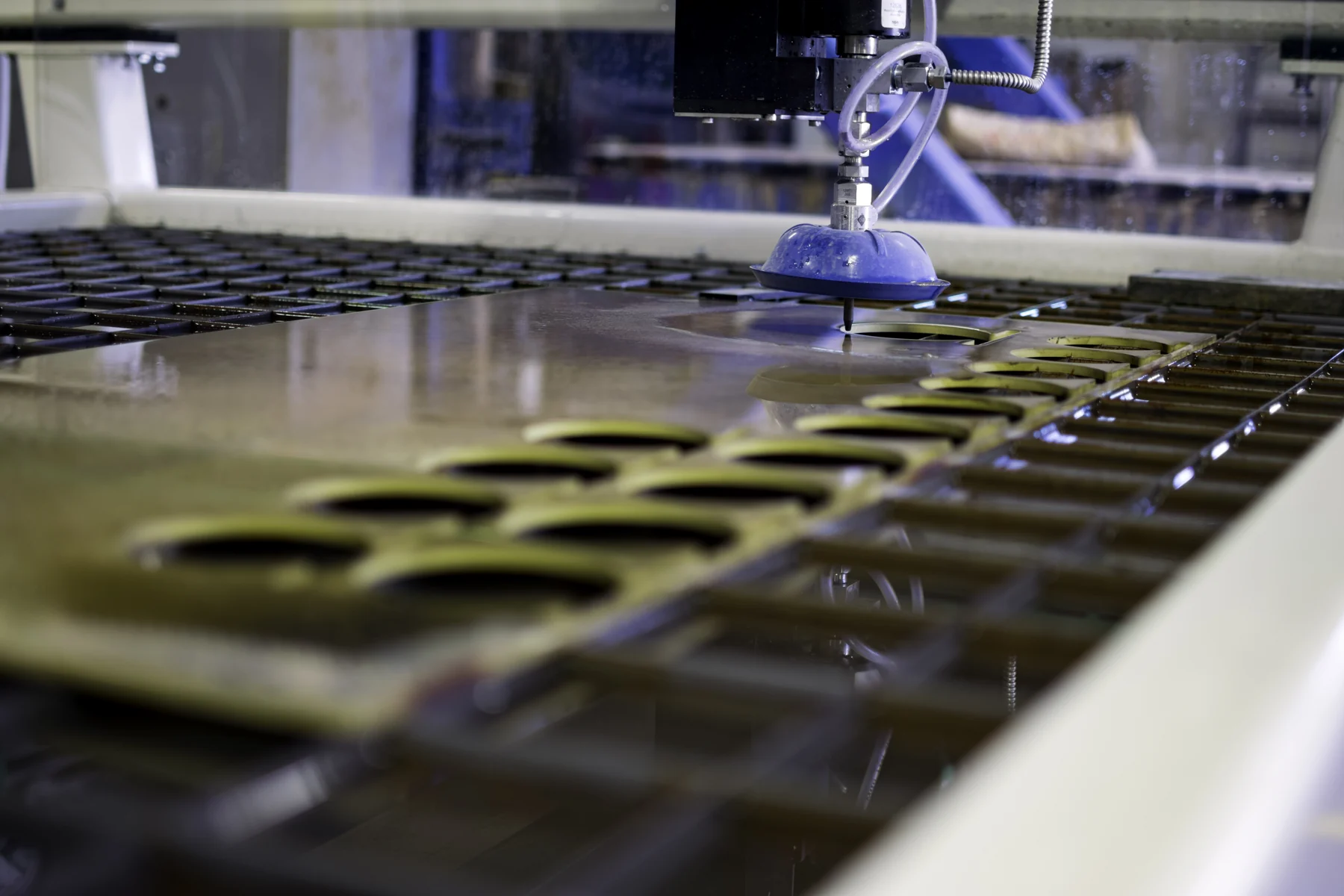

Material family is only the first filter
Waterjet cutting can process many materials. Pure water cutting is typically used for softer materials, while abrasive cutting is used for harder ones.
The specific material grade, thickness, layer structure, coating and finished product requirements affect the process. One successful application does not establish suitability for every similarly named material.
Metals
Steel, stainless steel, aluminium and many other metals can be cut with an abrasive waterjet. Avoiding thermal melting can be valuable for heat-sensitive or reflective materials.
Achievable edge quality, taper and cutting time must be assessed together with thickness and geometry. Nominal machine accuracy is not a guaranteed finished dimension for every metal part.
Stone, ceramics and glass
For these materials, the initial condition, support and piercing strategy are particularly important. Brittleness can require a different approach to hole starts and fine details than sheet metal.
Always specify the exact glass type, heat treatment and layer structure. Do not treat prestressed, laminated or specialist material as ordinary glass; machinability requires a separate assessment.
Foam, rubber, textiles and some plastics
Pure water cutting can be suitable for softer materials. Water sensitivity, compressibility, structure and workholding are important selection factors.
For food-processing applications, hygiene and cleanability are part of machine selection. A general industrial configuration cannot be assumed suitable for food processing solely because of its cutting principle.
Composites and layered structures
For composites, composition and layer structure are essential details. The risk of layer damage during piercing and cutting must be assessed for the specific structure.
Specify any bonds, coatings or internal layers important to the finished product's function. Material documentation alongside the drawing can also help the discussion.
Thickness alone is not enough
Always pair a question about maximum cutting thickness with the material, quality and time available. There is no single limit for every machine and material.
A technical quotation must specify geometric tolerances, edge quality and any finishing work alongside machinability. Trial cutting can help where application suitability is uncertain.
Manufacturer documentation and technical references
How waterjet cutting worksAccuracy and edge finish